
Chile
Hachas de abordaje
March 2026
Prior to independence, Chile was controlled by Spain. The movement to independence was assisted by Napoleon’s conquest of Spain that severely limited its colonial power.
In Chile a long and complex struggle began in 1810, a formal declaration of independence was made in 1818 and the final defeat of the Spanish and Royalist forces was completed by 1826. Spain formally recognised Chile in 1844.
Chile has a long tradition of seafaring skills and under colonial rule ships up to frigate size were built for the Spanish navy.
The Chilean Navy was established in 1817 under the guidance of General Bernardo O'Higgins, who believed control of the sea was vital in the fight for independence. The First Chilean Naval Squadron was put together from captured or purchased second hand ships and crews were supplemented by British, Irish and American sailors.
Its first commander was Manuel Blanco Encalada. Another pivotal figure in the navy's early history was Lord Cochrane, who previously served as a successful captain in the British Royal Navy, who was hired to organise and command the fleet. He introduced British naval customs and played a crucial role in successes against Spanish loyalist forces.
It is not known for sure what weapons were favoured by the early navy but it is likely that the crews used what they were most familiar with Spanish or British or copies of those weapons.
The Chilean Navy maintained strong links with Britain and from the mid 19th century many ships were built for it in British shipyards. These included corvettes, central battery ironclads and later in the century armoured cruisers. Guns were supplied by Armstrong and there are records that indicate cutlasses and boarding axes were also purchased from Britain.
The two central battery ships the Almirante Cochrane (1874) and Blanco Encalada (1875) were both supplied with Adams M. 1872 Mk III revolvers, and these revolvers were also used in other ships.
It is thought that Adams as part of the contract were asked to supply boarding axes.
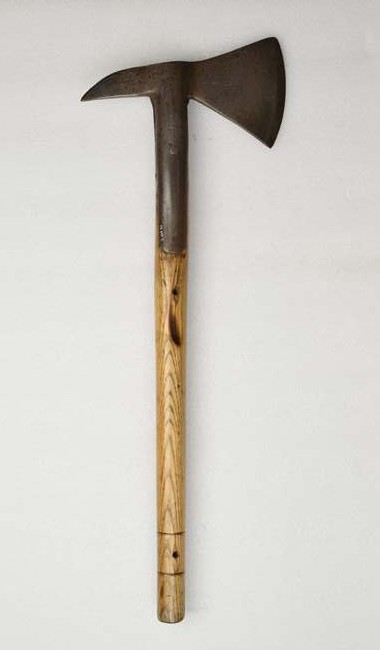
These two axes are held in the collection of the Museo Marítimo Nacional of the Chilean Navy and are close copies of the British 1859 boarding axe.
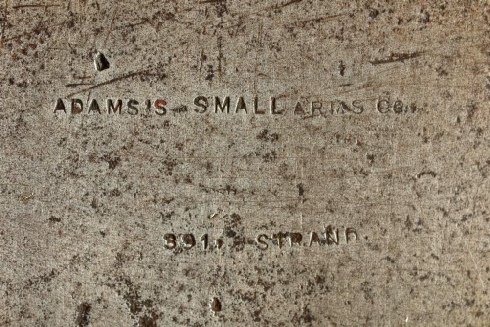
One is marked to the Adams Small Arms Company. It is probable that Adams sub contracted the manufacture of the axes as part of its pistol contract. The APSAM company of London also supplied boarding axes and 1845 type British cutlasses to the Chilean Navy.
It should be noted that these two axes do not have the distinctive ‘bell’ shape which is a feature on British government issue 1859 axes, as although the cutting edge is curved the top and bottom of the blades are straight and merge into the cutting edge with a slight bend rather than a straight line.
Courtsey of the National Maritime Museum of Chile
Chilean/British c.1870
Overall Length: (xx cm)
Blade -
Blade width : (xx cm)
Length Langets: (xx cm)
(Measurements to be added later)
Marking:
Adam’s Small Arms Co.
391 Strand
Although steam ships began to replace sail from the 1830s onwards, many iron steam ships were still fitted with masts and significant sailing rigging. A problem with steam was carrying enough coal for a long voyage so reverting to sail when possible was a good option.
So the need for boarding axes did not entirely disappear with the introduction of steam but with iron and steel decks the need for spikes was reduced.
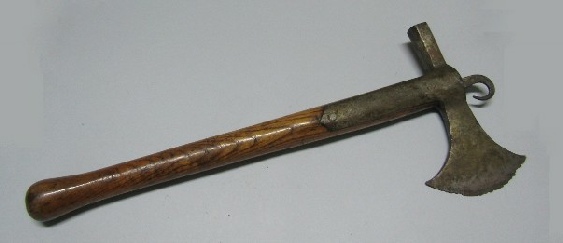
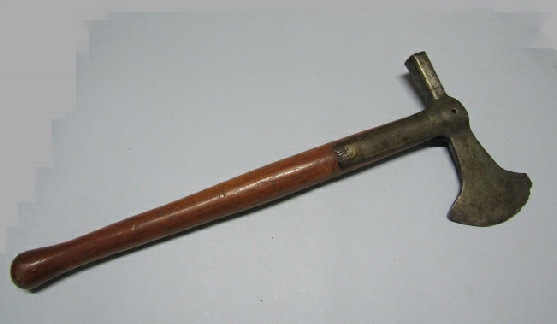
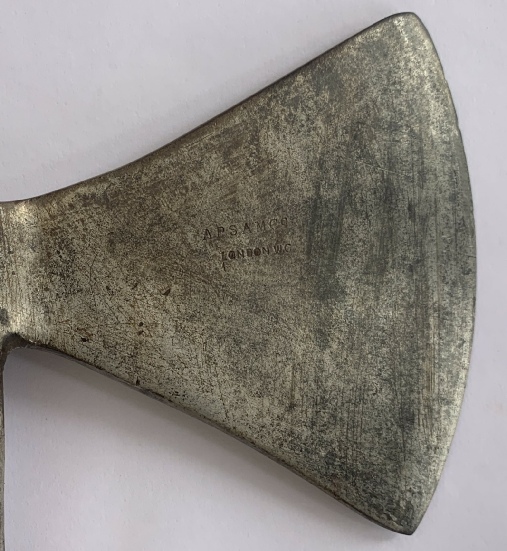
These two axes with hammer polls were donated to The Museo Histórico Nacional from the Chilean Naval Arsenal and are presumed as being in shipboard use in the last quarter of the 19th century.
Chilean c.1875
Overall Length: 16.5” (42cm)
Blade -
Overall Length: 12.6” (32cm)
Blade -
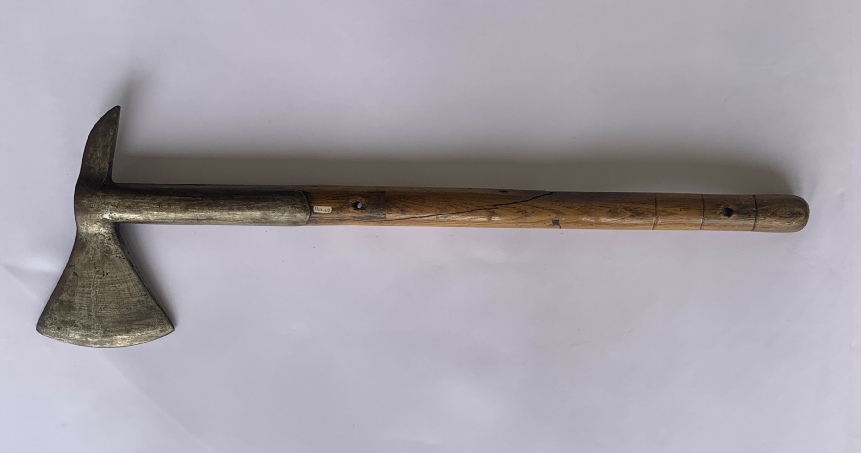
Chilean/British c.1870
Overall Length: (xx cm)
Blade -
Blade width : (xx cm)
Length Langets: (xx cm)
Maker: APSAM Co
London WC